
The account structures that worked a few years ago, with many ad sets split by interest, age and audience, now often hold Meta's system back. This guide shows the simpler structures that suit Andromeda, with templates for online stores, lead businesses and local businesses.
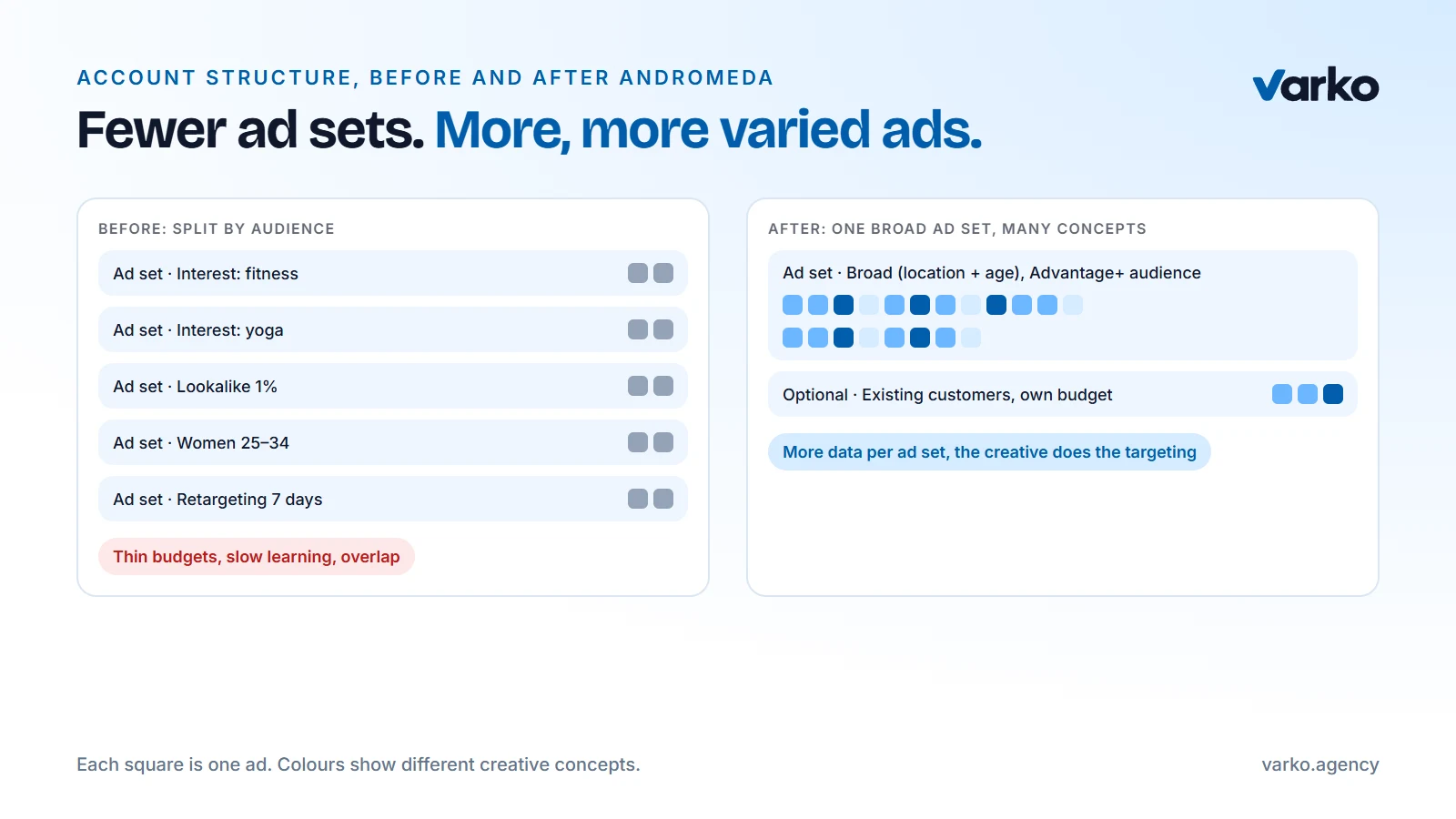
If you opened a typical Facebook ad account from 2021, you'd find dozens of ad sets: one per interest, one per lookalike percentage, one per age band, each with two or three ads and a small budget. That structure made sense when advertisers did the targeting. Since Meta Andromeda, the system does much of the targeting through the creative, and a fragmented structure mostly starves it of data.
Why consolidation works better now
- More data per ad set. Each ad set learns from its own results. Meta's learning phase needs around 50 optimisation events in a week to settle. Ten ad sets with a few results each may never get there; one ad set with all of them can.
- Less overlap. Several ad sets aimed at similar people bid against each other for the same users.
- More creative options per person. Andromeda picks from the ads available in the ad set. A broad ad set with many diverse ads gives it the most choice.
- Simpler to manage. Fewer places to check, fewer budgets to balance, and clearer reports.
The basic Andromeda structure
- One campaign per business goal. Sales for an online store, leads for a service business. Choose the campaign objective that matches the result you want.
- One main ad set, broad. Location, age and language if needed, Advantage+ audience on, and your best custom audiences added as suggestions rather than limits.
- Several genuinely different ads. Start with three to six concepts and add new ones regularly. See creative diversification.
- Optional second ad set for a specific reason: existing customers with their own budget, a different country, or a product line with different economics.
Templates for different businesses
Online store or D2C brand
- Campaign 1: Advantage+ sales campaign, purchase optimisation, broad, diverse creative plus catalogue ads.
- Optional campaign 2: a manual sales campaign for testing new concepts (see creative testing).
- Existing customers: either an existing-customer setting inside Advantage+ or a small separate ad set for launches and repeat purchases.
Retargeting doesn't always need its own campaign any more, because broad campaigns already reach people who visited. Keep a separate one only if you have a clear reason, such as a special offer for cart abandoners. See retargeting ads for online stores.
Lead business: real estate, clinics, coaching, services
- Campaign 1: leads objective, instant forms or WhatsApp, one broad ad set inside your service area, diverse ads that pre-qualify.
- If you run several projects or services with very different buyers (for example a luxury project and an affordable one), give each its own ad set or campaign with its own budget.
- Respect special ad categories for housing, jobs and credit, which limit targeting anyway.
Local business
- One campaign for calls, WhatsApp chats or bookings.
- One ad set targeting a realistic radius around you.
- Diverse ads showing the place, the people, the offer and customer reviews.
Campaign budget or ad set budget?
With one main ad set, the choice barely matters. With two or three, campaign budget (Advantage campaign budget) lets Meta move money to where results are cheapest, which usually works well. Use ad set budgets when you need guaranteed spend on something, such as a fixed budget for existing customers or a new market.
How much budget does a consolidated ad set need?
Enough to get a steady flow of results. A practical rule: daily budget of at least two to three times your target cost per result. If a purchase costs around ₹500, start around ₹1,000 to ₹1,500 a day for the main ad set. Our ad budget guide explains how to work this out from your margins.
Moving from an old structure to a new one
- Don't switch everything off at once. Build the new consolidated campaign alongside the old ones.
- Move your best ads in. Duplicate your strongest ads (keeping their post IDs where possible, to keep social proof) into the new ad set, plus new concepts.
- Shift budget gradually. Move 20 to 30 percent of budget every few days towards the new campaign as it proves itself.
- Pause the old ad sets once the new campaign is delivering at a similar or better cost for a week or two.
Self-assessment · about 2 minutes
Account structure health check
Answer for your main Facebook and Instagram ads account.
1. How many active ad sets are you running for the same goal?
2. Are your main ad sets split by interest, age or gender?
3. How many results (purchases or leads) does your main ad set get per week?
4. How many genuinely different ad concepts are in your main ad set?
5. How often do you change budgets, audiences or ads?
6. Do several ad sets target overlapping people?
Answer all 6 questions to see your result (0 done).
When more ad sets still make sense
- Different countries, languages or cities with different prices or delivery.
- Products with very different margins or buyers (for example, ₹500 accessories and ₹50,000 furniture).
- Existing customers you want to spend a fixed amount on.
- Regulated categories where targeting is restricted anyway.
- A separate test ad set for new concepts, if you prefer controlled tests.
Common structure mistakes
- Restarting learning constantly by editing budgets and ads every day.
- Duplicating winning ad sets to "scale", which creates overlap.
- Running the same ads in many ad sets, so they compete with themselves.
- Leaving dozens of paused, half-finished campaigns that make reporting confusing.
- Splitting by placement (Feed only, Reels only) without a strong reason.
Worked example: restructuring a ₹2,000-a-day store
Here's an illustrative example of a typical restructure. A home décor store spends ₹2,000 a day across seven ad sets: three interest ad sets (home décor, interior design, gardening), two lookalikes (1% and 3%), one retargeting ad set and one ad set for women 25 to 44. Each has two or three ads, mostly versions of the same lifestyle photo. Each ad set gets roughly ₹285 a day and three to six purchases a week, so none ever leaves learning.
The new setup: one sales campaign with one broad ad set (India, 22 to 60, Advantage+ audience with the customer list as a suggestion), carrying six concepts: a founder video, a customer room tour, a price-led static, a festive gifting carousel, a catalogue ad and a problem-solution Reel ("bare walls?"). It launches at ₹600 a day while the old ad sets keep running, then takes 20 to 30 percent more of the budget every few days. After three weeks the old ad sets are paused. The new ad set now gets 25 to 35 purchases a week, enough to learn and enough to see which concepts win.
A naming convention that keeps things clear
- Campaign: Goal_Type_Market, for example Sales_ASC_India or Leads_Form_Mumbai.
- Ad set: Audience_Note, for example Broad_AdvAudience or ExistingCustomers.
- Ad: Concept number, angle, person, format and month, for example C04_Gift_Couple_Carousel_Nov.
With few ad sets, the ad names do most of the reporting work. Consistent names make it easy to see which angles and formats win.
Structure for several cities or regions
If you serve several cities with the same product and prices, one ad set covering all of them is usually best. Split by city only when something important differs: delivery times, prices, language, or a physical location people must visit. For a real estate developer with projects in two cities, each project gets its own campaign, because the buyers, prices and sales teams differ.
Reporting after you consolidate
- Use breakdowns (age, gender, region, placement) to see where results come from, instead of separate ad sets.
- Group ads by naming tags to compare concepts and angles.
- Track results weekly rather than daily, since consolidated ad sets swing less but daily numbers still bounce.
- Compare total store revenue or total leads with total spend monthly, to keep platform reporting honest.
Our explainer on reading your ads report covers which numbers matter.
Signs your structure is working
- The main ad set leaves the learning phase and stays out of it.
- Cost per result steadies over two to four weeks.
- Several concepts receive meaningful spend, not just one.
- Frequency stays stable as budget grows.
Next in the series: targeting after Andromeda. Or return to the main Andromeda guide. For the basics of setting up campaigns, see our Facebook and Instagram ads guide.
Want someone to restructure your account properly? Varko sets up and runs Facebook, Instagram and Google ads for one fixed fee. Book a free 30-minute call.
Frequently asked questions
Usually yes, if they share similar prices and margins. Split only when economics or buyers are very different, so each group gets the budget it deserves.
A new ad set starts learning from scratch, which is why you build it alongside the old structure and move budget gradually rather than switching everything off at once.
Meta allows up to 50 ads per ad set. You rarely need that many. Diversity of concepts matters far more than count.
No. For many small businesses one well-funded broad ad set with diverse ads is the best structure available.