Meta now says creative diversification, not targeting, is the main way to reach the right people. But most advertisers diversify the wrong things. This guide shows what real diversification looks like, how to plan it on a small budget, and how to check whether your ads are different enough.
For years, the craft of Facebook advertising was finding the right audience: stacking interests, building lookalikes, excluding the wrong people. Since Meta Andromeda arrived, Meta's own advice has flipped. In April 2025 it wrote that the focus has shifted from niche targeting to creative diversification as the best lever for reaching relevant people.
That's good news for small businesses. You don't need a data team to build audiences. You need a steady supply of genuinely different ads, which a phone and a clear plan can produce. This guide shows how.
What creative diversification actually means
Meta defines creative diversification as creating a wide range of ad creatives with different themes, messages and visuals to cater to diverse audience segments. In plain words: different ads for different reasons people might buy from you.
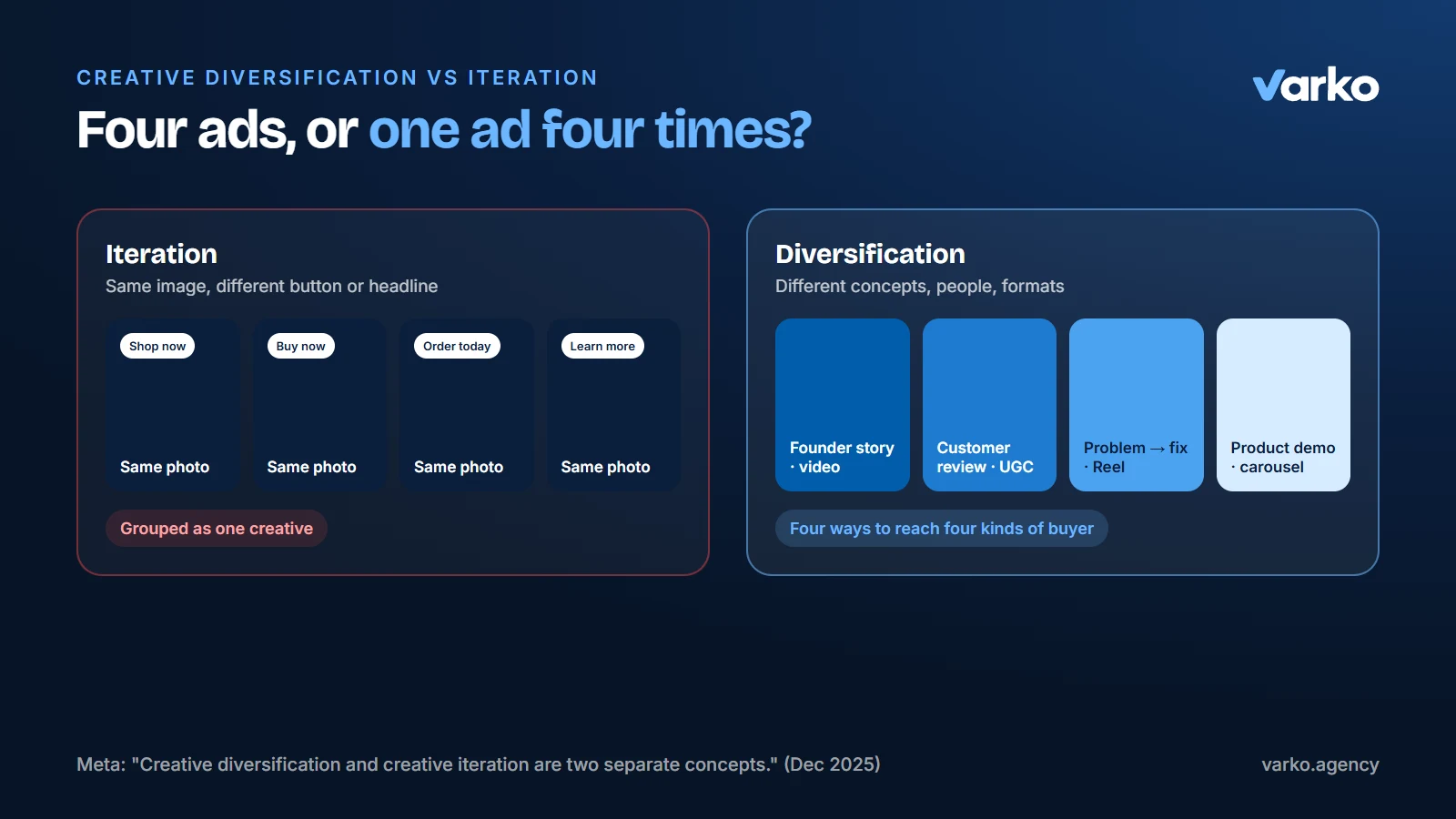
In December 2025 Meta added an important clarification: "creative diversification and creative iteration are two separate concepts." Its example of iteration was two ads with identical visuals and different calls to action. Iteration is useful for polishing an idea. It doesn't give the system a new idea.
Why diversity matters to Andromeda
Andromeda's job is to find, for each person, the ads most likely to be relevant. It learns from the content of each creative. Meta also says its system groups ads that share key visual and thematic attributes and shares learnings across them.
Put those together and the logic is clear. Ten near-identical ads behave like one ad reaching one kind of person. Ten genuinely different ads give the system ten different keys for ten different doors: the bargain hunter, the quality seeker, the gift buyer, the worried parent, the busy professional.
The five dimensions of diversification
When planning ads, change at least one of these meaningfully for each new concept, ideally two or more:
1. The angle (why someone buys)
- Price or value: "Premium cotton bedsheets under ₹999"
- Quality or durability: "Still soft after 100 washes"
- Convenience or speed: "Delivered tomorrow in Pune"
- Status or identity: "What design-loving homes are buying"
- Problem solved: "Tired of sheets that pill after a month?"
- Gifting or occasion: "The Diwali gift that gets used every day"
2. The person (who it speaks to)
Show and speak to different buyers. A coaching institute might make one ad for students, one for parents and one for working professionals returning to study. A skincare brand might feature a college student, a new mother and a woman in her forties. Different faces and situations help the system match ads to different people.
3. The proof (why they should believe you)
- Customer reviews and ratings
- A demonstration or before-and-after (within ad rules)
- Numbers: orders delivered, years in business, students placed (only if true)
- Founder or expert credibility
- Press mentions or awards
4. The format
Vertical video for Reels and Stories, square or 4:5 images for the feed, carousels for ranges or steps, and catalogue ads for stores. Each format is shown in different placements and suits different moods.
5. The style
Polished brand shoot, phone-shot UGC-style video, founder talking to camera, text-on-screen explainer, meme or trend format, simple product photo with a bold price. Our post on Reels ads that stop the scroll has ideas for video.
Examples for Indian businesses
A D2C kurta brand
- Founder video: why she started making cotton kurtas that don't fade.
- Customer try-on Reel: three body types, same kurta, honest fit notes.
- Static image: festive set, price and "free delivery" for the gifting angle.
- Carousel: five colours of the bestseller for people who like to browse.
- Problem ad: "Kurtas that shrink after one wash?" with a wash-test video.
A real estate developer
- Site walkthrough video with the actual sample flat.
- Static: price, location and possession date, for serious buyers.
- Family angle: schools, parks and commute times nearby.
- Investor angle: rental demand and area growth (only verifiable facts).
- Testimonial from an existing resident in a previous project.
See real estate ads in India for how to turn these into site visits.
A dental clinic
- Dentist introducing the clinic and team.
- Patient story (with consent and within medical ad rules).
- Offer: check-up and cleaning price.
- Comfort angle: "Nervous about the dentist?" showing the calm clinic.
- Convenience: evening and Sunday appointments, WhatsApp booking.
How many concepts do you need?
Meta hasn't published a number, and it dropped its older advice of about six ads per ad set. In our experience a healthy rhythm for a small business is:
- Launch: three to six clearly different concepts in your main ad set.
- Every two weeks: add two or three new concepts, informed by what's working.
- Monthly: retire concepts that never got delivery or clearly lost, and refresh winners with new hooks.
Budget sets the ceiling. Each concept needs enough spend to show what it can do, so a ₹1,000-a-day ad set will struggle to give 20 concepts a fair chance. Our ad budget guide explains how to size it.
Making diverse creative on a small budget
- Batch film. Spend one afternoon filming many short clips: product close-ups, you talking, a customer, the packing table, the shop. Edit them into several concepts.
- Interview customers. Five minutes on a phone call with a happy customer gives you their words for ads, and maybe a video review.
- Write angles first. List ten reasons people buy from you. Each is a concept.
- Use Meta's tools carefully. Flexible format and Advantage+ creative can produce variations, but they mostly iterate on what you give them. They don't replace new concepts.
- Work with creators. Small creators whose followers match your buyers produce natural, different-looking content. Agree that you can run it as ads, and mark paid partnerships clearly.
Our ad creative guide covers hooks, formats and filming in detail.
Self-assessment · about 2 minutes
Is your creative diverse enough for Andromeda?
Think about the ads in your main ad set right now and answer honestly.
1. How many genuinely different concepts are running (not variations of one)?
2. Do your ads show different kinds of people or buyers?
3. How many formats are you using (Reels video, static, carousel, catalogue)?
4. How many different reasons to buy do your ads lead with?
5. When did you last add a brand-new concept (not a tweak)?
6. Do any of your ads use real customers, reviews or UGC-style video?
Answer all 6 questions to see your result (0 done).
Mistakes that look like diversification but aren't
- Same image with ten different headlines.
- Same video with a different first frame colour.
- One product photo cropped three ways.
- Ten ads that all lead with "flat 40% off".
- AI-generated background swaps on the same product shot, presented as new concepts.
These are fine as iterations of a proven concept. Just don't count them as your creative variety.
How to tell if diversification is working
- Spend is spread across several concepts rather than one ad taking almost everything.
- Different concepts win with different age groups, placements or regions (check the breakdowns in Ads Manager).
- Frequency stays healthier, because you're reaching new people rather than the same ones again.
- Cost per result is steadier over weeks, with less ad fatigue.
A concept planning worksheet
Use this simple grid each month. Write one line per concept, and make sure no two lines share the same angle, person and format:
- Angle: the reason to buy (price, quality, convenience, problem, status, gift, occasion).
- Person: who it speaks to and who appears in it.
- Proof: review, demo, numbers, founder, creator.
- Format: Reel, static, carousel, catalogue.
- Hook: the first line or first two seconds.
- Offer: what they get and why now, only if it's real.
For example, a home bakery in Pune might plan: (1) price angle, office workers, static, "Fresh cakes from ₹499, delivered in 3 hours"; (2) occasion angle, parents, Reel of a birthday cake being decorated; (3) quality angle, food lovers, close-up video of real butter and fresh fruit; (4) proof angle, everyone, carousel of customer photos and reviews; (5) convenience angle, last-minute buyers, "Forgot the anniversary? Order by 6 pm".
Name your ads so you can learn from them
Diversification only helps if you can see which concepts win. A consistent naming pattern makes reports readable at a glance. We use: concept number, angle, person, format, and date. For example: C07_Quality_Mother_Reel_Nov. When you filter Ads Manager by "Quality" or "Reel", patterns appear quickly: maybe quality angles win with women over 35, while price angles win with students.
Diversity across new and returning buyers
With broad campaigns, the same ad set reaches people who've never heard of you and people who visited yesterday. Your creative mix should serve both:
- For strangers: strong hooks, clear problem and benefit, social proof. They need to understand what you are in two seconds.
- For warm visitors: reviews, guarantees, delivery details, answers to common doubts. They're deciding whether to trust you.
- For past buyers: new launches, complementary products, refills and loyalty offers.
Andromeda can match these to the right people, but only if you've made them.
How to brief creators for diverse content
- Pick creators whose audience and look match different buyer types, not all the same profile.
- Give each a different angle to cover, rather than the same script.
- Ask for raw, natural footage: unboxing, first use, honest opinion, before-and-after where allowed.
- Request several hooks for the first two seconds, so you can test them.
- Agree in writing that you can run the content as ads, and for how long.
- Make sure paid partnerships are clearly disclosed, in line with ASCI guidelines.
A realistic monthly creative budget
Diversity doesn't require a big production budget. A practical monthly mix for a small brand: two phone-shot founder or team videos, two customer or creator videos, three or four static images built from product photos and reviews, and one carousel. That's eight to ten pieces, roughly what Varko's plans include each month, and enough to keep a single ad set fresh.
Next in the series: how to structure campaigns so these ads get a fair chance, in campaign structure for Andromeda. Or go back to the main Andromeda guide.
Varko plans and makes 8 new creatives a month for every client, 6 images and 2 short videos, built around diverse concepts. See pricing or book a free call.
Frequently asked questions
Not by itself. Dynamic creative and flexible formats mix the assets you upload. If those assets are all variations of one idea, the result is iteration. Feed them genuinely different images, videos and messages to get diversity.
With a consolidated structure you'll have few ad sets, so most of your diverse creative lives together in the main one. That's intended: it lets the system match each concept to the right people.
Yes. Diverse creative helps the right people see you. It can't fix an unattractive price, slow delivery or a weak product page.
They can help produce variations quickly. The new concepts, angles and real customer proof still need to come from you or your agency, because they come from understanding your buyers.