
Andromeda is the system Meta now uses to decide which ads are even considered for each person on Facebook and Instagram. It changed what works: creative variety matters more than clever targeting, and simple account structures beat complicated ones. This guide explains how it works and exactly what to do about it.
If your Facebook and Instagram ads have behaved differently over the last year, with costs moving, old winning ads fading faster, and "broad" audiences suddenly beating carefully built interest stacks, there is a good chance Andromeda is part of the reason. It is one of the biggest changes Meta has made to how ads are delivered since the move to automated bidding, and it rewards a different way of running campaigns.
This is the main guide in our Meta Andromeda series. It explains what Andromeda is in plain words, what Meta has actually said about it (and what is just rumour), and how small businesses and brands in India should adjust their ads. Each section links to a deeper guide, and the quiz near the end checks what you've picked up.
What is Meta Andromeda?
Meta Andromeda is a machine learning system that handles ad retrieval: the very first step in deciding which ad you see when you scroll Facebook or Instagram. Meta introduced it in a December 2024 engineering post, describing it as its "next-generation personalized ads retrieval engine", built to support the growing number of ads created with Advantage+ automation and generative AI tools.
Every time someone opens Facebook or Instagram, there may be tens of millions of ads that are technically eligible to show to them. No system can score every one of those in a fraction of a second. So Meta works in stages. Retrieval comes first and narrows the pool to a few thousand relevant candidates. Then larger ranking models score that shortlist, and an auction picks the winner. Andromeda is the stage that builds the shortlist.
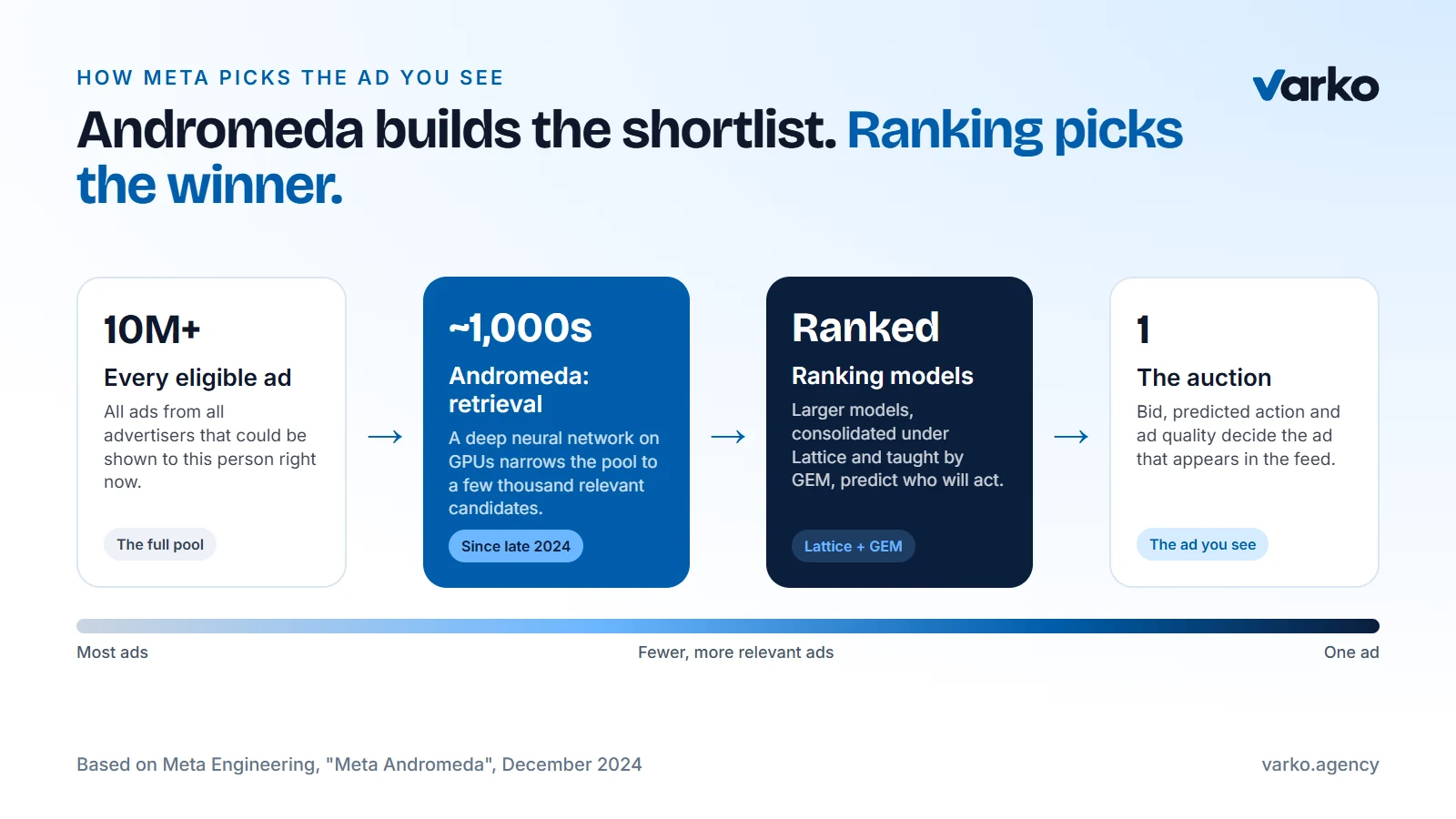
That matters more than it sounds. If your ad isn't retrieved, it can't be ranked, and it can't win the auction, no matter how good your bid is. Andromeda effectively decides which of your ads get a chance with which people.
How Andromeda works, without the jargon
Meta's engineering team described Andromeda's design in some detail. You don't need to understand the maths, but four ideas explain why it behaves the way it does:
- A much bigger model. Older retrieval systems had to be simple to be fast. Andromeda runs a custom deep neural network on NVIDIA Grace Hopper hardware, and Meta says it allowed a 10,000x increase in the complexity of the models used for retrieval. More complexity means it can learn subtler links between people and ads.
- It reads the ad itself. The model learns from signals about each ad and each person, including the content of the creative. An ad about "monsoon-proof school shoes" is understood differently from one about "office loafers", even if both target the same audience settings.
- A layered index of ads. Ads are organised into a hierarchy, so the system can zoom in on the most relevant groups instead of checking every ad. Meta says this, trained together with the model, finds relevant ads better than older methods.
- Different effort for different ads. Meta describes "model elasticity": using heavier computation where it matters most and adjusting in real time to available capacity.
The headline results Meta reported after rolling Andromeda out on Facebook and Instagram were a 6% improvement in recall (finding more of the relevant ads) and an 8% improvement in ads quality on selected segments. Those are system-wide averages, not promises for any single account, but they explain why Meta has kept building on it.
Where Andromeda fits with GEM and Lattice
You'll often see Andromeda mentioned alongside two other names. They are different parts of the same system:
- Andromeda handles retrieval: the shortlist.
- Lattice is Meta's architecture for consolidating many separate ranking models into fewer, larger ones that learn across objectives. Meta first described it in 2023.
- GEM (Generative Ads Recommendation Model) is a large foundation model Meta announced in November 2025. It acts as a "teacher", passing what it learns to the models that serve ads. Meta reported that GEM's launch lifted ad conversions by about 5% on Instagram and 3% on Facebook Feed.
Together they mean Meta's system now makes far more of the decisions an advertiser used to make by hand. We go deeper in Andromeda, GEM and Lattice explained.
What Meta has actually said to advertisers
A lot of Andromeda advice online is guesswork. These are the points that come from Meta itself:
- Creative diversification is the main lever. In April 2025 Meta wrote that the focus has shifted from niche targeting to creative diversification, which it defines as creating a wide range of ad creatives with different themes, messages and visuals to suit different audience segments.
- More creatives help the system personalise. In a March 2025 post on ad ranking, Meta explained that as businesses upload more creatives to support diversification, Andromeda can pick the right one for each person.
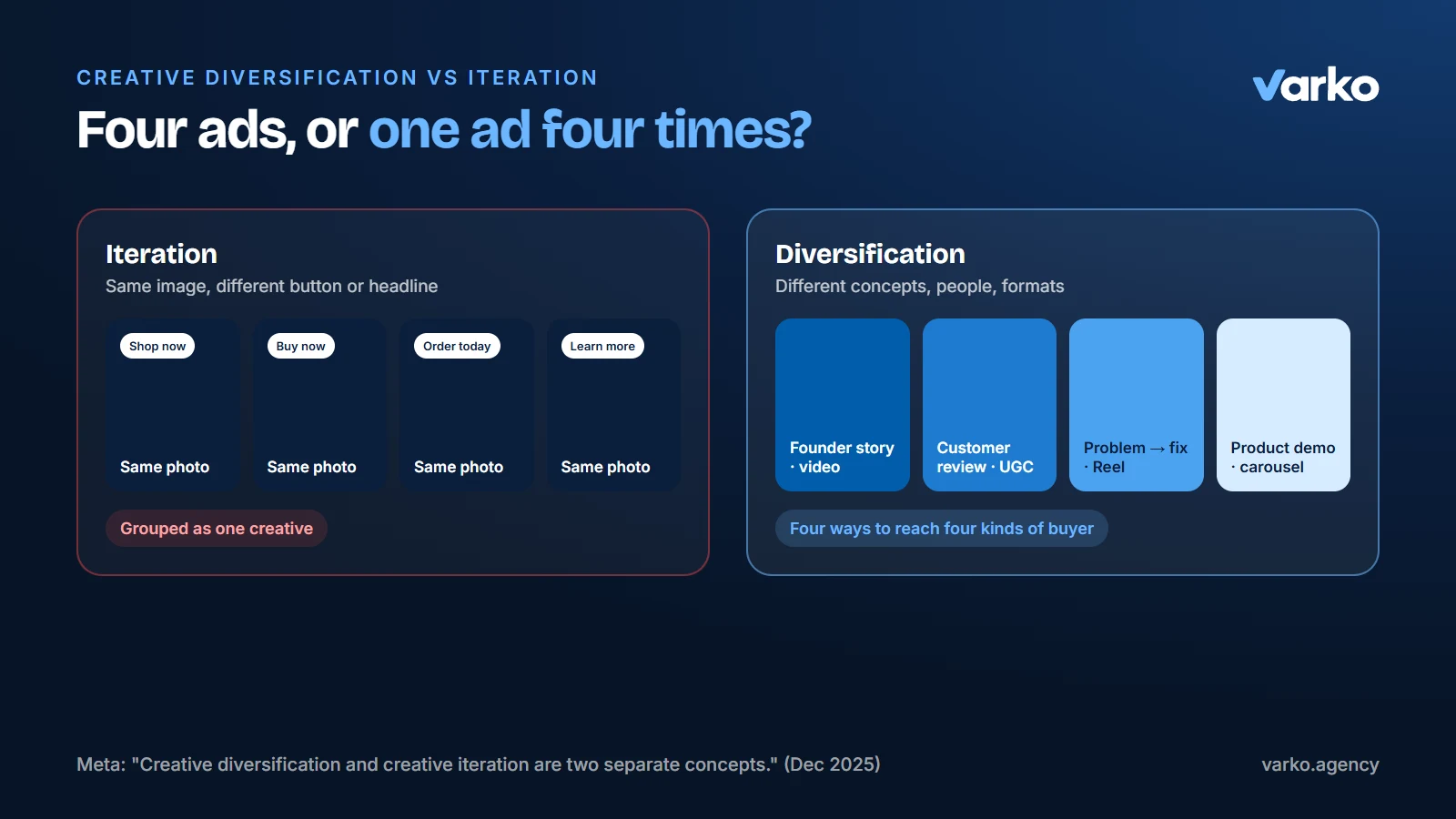
- Diversification is not iteration. In December 2025 Meta stressed that "creative diversification and creative iteration are two separate concepts". Two ads with the same visual and a different call to action are iteration, not diversity.
- Similar ads are grouped. Meta said its system analyses creatives and groups ads that share key visual and thematic attributes, sharing learnings across them. Near-copies don't count as new ideas.
- There's no magic number. Meta has not published a required number of ads. Its older advice to keep ad sets to around six ads has quietly gone.
Treat any claim beyond these, such as exact "similarity scores" or secret thresholds, with caution. Meta hasn't published them.
Why your ads may have changed
Advertisers commonly notice a few patterns after Andromeda. Each has a logical explanation:
- Winning ads fade faster. If most of your ads are variations of one idea, they're grouped and compete for the same slice of people. When that slice is tired of the idea, the whole group slows down.
- Interest targeting matters less. The system increasingly finds people through the ad's content and its own signals, so tight interest stacks often just limit it.
- Too many ad sets spread data thin. Splitting budget across many small ad sets gives each one too few results to learn from, and they overlap.
- Bad tracking hurts more. The models optimise for the results you report. If purchases or leads are missing or duplicated, the system learns the wrong lesson faster.
It's also worth saying plainly: not every bad week is Andromeda. Seasonality (costs rise before Diwali and big sale days), a weak offer, a slow website or a broken pixel cause far more trouble. Our Andromeda audit helps you tell the difference.
What to change: the Andromeda playbook
1. Diversify your creative, properly
Make ads that differ in concept, not just colour. Different angles (price, quality, convenience, status), different people (a student, a parent, a professional), different formats (Reels, static images, carousels) and different styles (founder talking to camera, customer review, product demo). Each genuinely different ad gives Andromeda a new way to reach a new kind of buyer. See creative diversification for Andromeda.
2. Simplify your campaign structure
Fewer campaigns and ad sets, each with more budget and more ads, usually work better now. A common starting point is one sales or leads campaign with one broad ad set holding several diverse ads, plus an optional ad set or budget for existing customers. Details in campaign structure for Andromeda.
3. Go broad, and let the creative target
Set the location, age range and anything legally or practically required, and let the system find people. Keep custom audiences and lookalikes as signals rather than walls. Read targeting after Andromeda for when narrow targeting still makes sense.
4. Use Advantage+ where it fits
Andromeda was built to handle the volume that Advantage+ campaigns create. For most online stores with reliable purchase tracking, Advantage+ sales campaigns are worth testing. See Advantage+ in the Andromeda era.
5. Fix tracking before anything else
Install the Meta pixel and the Conversions API, check that each purchase or lead fires once with the right value, and send lead quality back to Meta where you can. Our ad tracking guide shows how to test it.
6. Test concepts, not tweaks
Testing a red button against a blue one tells you little now. Test new concepts, keep the winners running, and make new versions of what works. The full method is in creative testing under Andromeda.
How many ads do you need for Andromeda?
Meta gives no fixed number, and more ads don't automatically mean better results. What matters is how many genuinely different ideas you have. A practical rule we use: start an ad set with three to six clearly different concepts, add two or three new concepts every couple of weeks, and pause ads that clearly aren't getting delivery or results. Bigger budgets can support more concepts, because each needs enough spend to show what it can do.
For a small business, that's very achievable. Phone-shot videos, customer reviews, a founder explaining why the product exists, a before-and-after: these are all different concepts, and none need a studio. Every Varko plan includes 8 new creatives a month for exactly this reason. See pricing.
What Andromeda means for different businesses
- Online stores and D2C brands: creative variety across products and buyer types, Advantage+ sales campaigns once tracking is solid, and judging results on delivered orders. See Andromeda for online stores and how we help online stores.
- Lead businesses (real estate, clinics, coaching, services): diverse ads that pre-qualify, plus sending lead quality back to Meta so the system learns which people become customers. See Andromeda for lead generation and enquiries and calls.
- Local businesses: broad targeting inside a realistic radius, with ads that show the place, the people and the offer.
Common Andromeda myths
- "Andromeda decides which ad wins." No. It builds the shortlist. Ranking models and the auction pick the winner.
- "You need 50 ads per ad set." No such rule exists. Diversity of ideas matters more than volume.
- "Targeting is dead." Targeting still matters for location, legal limits and some niche B2B cases. It's just no longer the main lever.
- "Andromeda ruined my account." Sometimes. More often, results changed because of creative fatigue, tracking, season or offer. Check those first.
Quick quiz · 6 questions
How well do you know Meta Andromeda?
Six quick questions on what you've just read.
1. Which stage of Meta's ad delivery does Andromeda handle?
2. According to Meta, what is now the main lever for reaching the right people?
3. You run four ads with the same photo and different button text. What does Andromeda likely see?
4. What is GEM?
5. Which structure usually suits Andromeda best?
6. Results dropped this week. What should you check first?
0 of 6 answered
How we got here: a short timeline
Andromeda makes more sense once you see the changes that led to it. Each step moved decisions from advertisers to Meta's systems:
- 2021: Apple's App Tracking Transparency on iOS reduced the data available for targeting and measurement. Advertisers leaned harder on broad audiences and the Conversions API.
- 2022: Meta launched Advantage+ shopping campaigns, automating audiences and placements for online stores.
- 2023: Meta described Lattice, a new architecture that consolidates many ranking models so they learn across goals and surfaces.
- 2024: Andromeda, the new retrieval engine, rolled out across Facebook and Instagram, with a 10,000x increase in retrieval model complexity.
- 2025: Meta told advertisers that creative diversification had replaced niche targeting as the main lever, renamed Advantage+ shopping to Advantage+ sales, and introduced GEM, a foundation model that teaches its ad-serving models.
The direction is clear: Meta's systems decide who sees what, and advertisers win by giving them better inputs, meaning accurate conversion data and genuinely different creative.
What Andromeda doesn't change
It's easy to treat Andromeda as a reason to change everything. Some fundamentals are exactly where they were:
- The auction. Meta still combines your bid, the predicted chance of the result you want and ad quality into a total value. The highest total value wins. Andromeda decides which ads get into that contest, not how it's scored.
- Your offer. A better price, faster delivery or a stronger guarantee still beats any setting.
- Your landing page. A slow, confusing page loses the people Andromeda found. See landing page.
- Budget maths. You still need enough budget to get results the system can learn from. See the ad budget guide.
- Follow-up. For lead businesses, how fast you call still decides most deals. See speed to lead.
A 30-day Andromeda action plan
If you want a simple order to work in, this is the plan we use when we take over an account:
- Days 1 to 3, tracking. Test purchase or lead events in Events Manager, remove duplicate pixels, switch on the Conversions API, and check values and currency.
- Days 3 to 7, creative. List the five to ten reasons people buy from you and the kinds of people who buy. Produce three to six distinct concepts covering different angles, people and formats.
- Days 7 to 10, structure. Build one broad campaign and ad set alongside your current setup. Move your best ads and the new concepts into it.
- Days 10 to 21, shift budget. Move 20 to 30 percent of budget every few days towards the new campaign as it proves itself. Change nothing else daily.
- Days 14 to 28, test. Add two or three new concepts every two weeks. Read results on cost per real result, not clicks.
- Day 30, review. Compare cost per result and, for stores, delivered-order ROAS with the previous month, adjusting for season. Plan next month's concepts from what won.
Andromeda terms in plain English
- Retrieval: picking a shortlist of possible ads for a person. Andromeda's job.
- Ranking: scoring the shortlisted ads by how likely the person is to act.
- Recall: how many of the truly relevant ads the system manages to find.
- Creative diversification: running genuinely different ad concepts, not small variations.
- Creative iteration: small changes to one concept, such as a new headline or button.
- [Advantage+](/glossary/advantage-plus-sales): Meta's automated campaign and creative features.
- [Learning phase](/glossary/learning-phase): the period after launch or major edits when delivery is still settling.
- [Conversions API](/glossary/conversions-api): sends results from your server to Meta, catching what browsers miss.
More definitions are in the Varko glossary.
The Meta Andromeda series
- Creative diversification for Andromeda
- Campaign structure for Andromeda
- Targeting after Andromeda
- Andromeda, GEM and Lattice explained
- Advantage+ in the Andromeda era
- Creative testing under Andromeda
- Andromeda for online stores and D2C brands
- Andromeda for lead generation
- The Andromeda audit: is it hurting your ads?
If you'd rather have someone adapt your account for you, Varko runs Facebook, Instagram and Google ads for small businesses for one fixed monthly fee, with 8 new creatives every month. See how it works or book a free 30-minute call.
Frequently asked questions
Meta introduced Andromeda in 2024 and described it publicly in a December 2024 engineering post. It has since been rolled out across Facebook and Instagram and kept improving through 2025.
No. Advantage+ is a set of automated campaign and creative tools that advertisers choose to use. Andromeda is part of Meta's delivery system that works behind every ad. Andromeda was built partly to handle the extra volume Advantage+ creates.
There's no switch to turn on. It's already working on your ads. What you can change is your creative mix, campaign structure, targeting and tracking, so the system has better material to work with.
Yes. It affects every advertiser. Smaller budgets benefit most from consolidation, because splitting a small budget across many ad sets leaves each with too little data. See our ad budget guide.
Not useless, but rarely the best lever. Broad targeting with diverse creative usually performs as well or better. Narrow targeting still makes sense for strict location limits, very small niches and regulated categories.